Leave Your Message
Blog

Blog

What Is a Syringe Assembly Machine?

A Syringe Assembly Machine is an automated system designed to combine syringe components with consistent speed and precision. It may handle barrels, plungers, gaskets, needles, caps, and protective covers. Each part follows a controlled path through feeding, orientation, assembly, inspection, and discharge. Small errors matter. A poorly seated gasket can affect movement, sealing, or product performance.

Modern equipment often uses vibratory feeders, servo-driven stations, vision cameras, and pressure sensors. These technologies help manufacturers reduce manual handling and maintain repeatable assembly conditions. Operators can monitor torque, insertion force, component presence, and rejected units through a central control interface. Stainless steel surfaces also support practical cleaning routines in controlled production areas. However, automation alone does not guarantee quality.

Reliable syringe production requires validated processes, suitable materials, documented maintenance, and trained personnel. The machine must match the syringe design, production volume, and required inspection standards. A fast line may still create waste if components arrive inconsistently. That is easy to overlook. Engineers should review changeover time, cleaning access, safety controls, and data records before selecting equipment. Real-world performance depends on more than advertised speed. Factory trials, sample testing, and careful qualification can reveal problems that drawings hide. Even experienced teams may need to revise their assumptions. This guide explains how a Syringe Assembly Machine works, which features deserve attention, and how manufacturers can evaluate performance responsibly.
What Is a Syringe Assembly Machine?

Definition and Purpose of a Syringe Assembly Machine

What Is a Syringe Assembly Machine?

A syringe assembly machine is automated equipment that joins syringe components into a usable medical device. It can position the barrel, stopper, plunger, needle shield, and protective cap. The machine also checks alignment, insertion force, and component presence. Its purpose is simple: produce consistent assemblies with fewer manual handling risks. On a production floor, operators may see bowls feeding parts, sensors confirming placement, and rejected units moving into a sealed container. Small details matter.

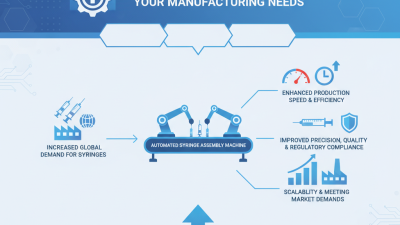
The World Health Organization estimates that about 16 billion injections are administered globally each year. This volume creates strong demand for reliable, repeatable syringe production. Grand View Research reported that the global prefilled syringes market was valued at approximately 7.1 billion US dollars in 2023. Such figures explain why manufacturers invest in controlled assembly systems. However, market growth does not remove engineering responsibility.

A capable machine should support cleanroom practices, traceability, adjustable formats, and documented quality checks. Vision inspection can detect missing stoppers or misaligned components. Force monitoring can identify unusual resistance during insertion. These controls improve consistency, but they are not perfect. Poorly calibrated sensors may accept defective units. In my view, skilled validation remains essential, even on highly automated lines. ISO 11040 standards and applicable regulatory guidance should shape equipment qualification, maintenance, and process verification.

Main Components and Machine Configuration

What Is a Syringe Assembly Machine?

Main Components and Machine Configuration

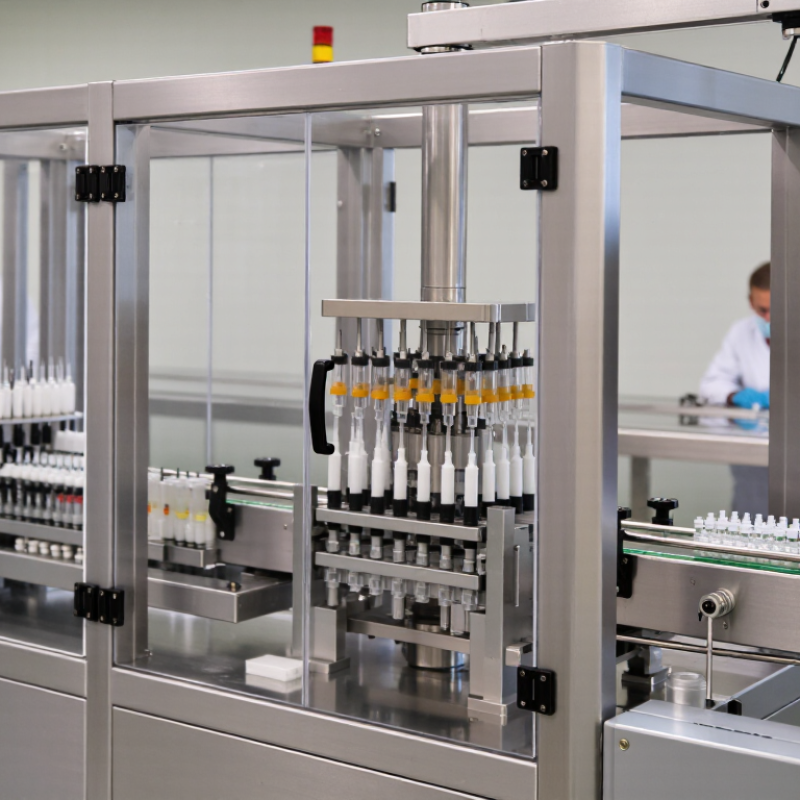
A syringe assembly machine combines feeding, orientation, assembly, inspection, and controlled discharge. Its first critical unit is the feeding system. A vibratory bowl or stepped feeder separates barrels, plungers, gaskets, and tip caps. Servo-driven conveyors then maintain spacing and orientation. Small errors matter.

The assembly section commonly includes a barrel transfer module, plunger insertion station, cap-fitting unit, and force-control mechanism. Optical sensors verify presence, position, and visible defects. Some configurations add leak testing, torque measurement, needle-shield placement, and automatic rejection. A programmable controller links each station, while recipe management supports different syringe sizes. Keep it modular. A practical configuration may use linear transport for gentle handling and rotary indexing for higher output. The right choice depends on product geometry, cleanroom limits, changeover frequency, and validation needs. Faster is not always better.

The World Health Organization has estimated that about 16 billion injections occur globally each year, highlighting the need for consistent assembly and inspection. A 2024 global prefilled-syringe market assessment projects strong growth through the decade, driven by injectable therapies and home-use formats. These figures support automation, but they do not remove process risk. ISO 13485-based quality systems require traceability, documented controls, and repeatable verification. In practice, operators still need careful setup checks. A perfect layout on paper can fail when components vary slightly, sensors become dusty, or changeovers take too long.

How the Syringe Assembly Process Works

What Is a Syringe Assembly Machine?

How the Syringe Assembly Process Works

A syringe assembly machine converts separated components into a controlled, inspected medical device. The process usually begins with feeding and orienting barrels, plungers, stoppers, needle shields, and protective caps. Vibratory bowls or robotic feeders position each part correctly. Precision servo systems then insert components with measured force. Small errors matter here.

The machine may apply lubricant, place the stopper, attach the needle, and fit the tip cap. Vision cameras inspect clarity, alignment, foreign particles, and component damage. Force sensors can detect incomplete insertion or abnormal resistance. Leak testing follows, often through pressure or vacuum methods. Accepted syringes move toward labeling and packaging, while rejected units are automatically separated. In production, operators still review alarms and sample results. Automation does not remove judgment.

The World Health Organization and UNICEF reported 14.5 million zero-dose children in 2023, showing the continuing need for dependable injection supply chains. Industry market assessments also indicate steady growth in disposable syringe demand, although estimates differ by product scope and region. That difference deserves attention. A fast machine is not automatically a reliable machine. Process validation, cleanroom control, calibration, and documented inspections determine practical performance. Operators should verify every setting against the approved process, because a seemingly minor stopper defect can affect dose accuracy or package integrity. More sensors may help, but they cannot replace disciplined maintenance and realistic rejection analysis.

Types of Syringe Assembly Machines

What Is a Syringe Assembly Machine?

Syringe assembly machines automate the joining of barrels, plungers, gaskets, needles, and protective caps. Their design depends on syringe structure, output targets, and required inspection steps. Clean handling matters because tiny particles can affect movement, sealing, or patient safety.

Types of Syringe Assembly Machines

Linear assembly machines move components through stations in a straight path. They suit moderate production volumes and offer clear access for adjustment. Rotary machines use a circular indexing table. They occupy less floor space and support faster, repeated operations. However, setup errors can spread across several stations quickly.

Nest-based machines hold syringes in trays or fixed pockets. This approach protects delicate parts and supports batch tracking. Robotic systems use controlled arms to pick, place, and inspect components. They can handle different syringe formats, but programming and validation require more time. Modular machines combine feeding, assembly, vision inspection, and packaging functions. They allow gradual expansion when production needs change.

A good machine may include sensors for missing parts, torque checks, dimensional inspection, and leak testing. Operators still need to verify alignment, feeder performance, and cleaning procedures. Automation reduces variation, but it does not remove responsibility. No design is perfect. A high-speed system may create more waste during changeovers, while a flexible system may produce fewer units per hour. Engineers should test real components before choosing equipment, because supplier drawings rarely reveal every feeding problem.

What Is a Syringe Assembly Machine? - Types of Syringe Assembly Machines

Comparison of common syringe assembly machine configurations and their typical applications

Machine type Typical assembly functions Automation level Representative output Best suited for Common quality controls
Manual assembly station Operator places the barrel, gasket, plunger rod, tip cap, needle shield, or other components using fixtures and hand tools. Manual Approximately 100–600 syringes per hour, depending on product design and operator skill. Small batches, development work, clinical trials, and frequent format changes. Visual inspection, component presence, plunger position, and basic dimensional checks.
Semi-automatic syringe assembly machine Guided loading with automated feeding or insertion of selected components, such as plungers, gaskets, rods, or tip caps. Partially automated; operator loading is usually required. Approximately 1,000–3,000 syringes per hour. Low-to-medium volume production and manufacturers requiring flexible changeovers. Presence sensors, component orientation, insertion force, reject confirmation, and cycle counting.
Fully automatic inline assembly machine Automatic feeding, orienting, assembling, inspection, rejection, and transfer of syringe components through a continuous production line. Fully automatic Approximately 3,000–12,000 syringes per hour, depending on the number of assembly stations and product format. High-volume production with consistent product specifications. Machine vision, force monitoring, leak or fit checks, missing-part detection, and automatic reject handling.
Nest-based syringe assembly machine Processes syringes held in a nest or tray, commonly including plunger insertion, tip-cap placement, inspection, and transfer to packaging. Semi-automatic to fully automatic Typically 1,000–8,000 syringes per hour, depending on nest size and cycle time. Pre-sterilized or ready-to-fill syringe formats that must remain organized and protected during handling. Nest presence, syringe orientation, component position, cosmetic inspection, and container closure checks.
Syringe barrel and plunger assembly machine Installs the stopper or gasket and inserts the plunger rod into the syringe barrel at a controlled depth. Semi-automatic to fully automatic Approximately 2,000–10,000 syringes per hour. Products where plunger travel, stopper seating, and smooth movement are critical. Insertion depth, axial force, plunger movement, stopper presence, and barrel damage detection.
Needle and safety-device assembly machine Attaches a needle, needle hub, safety shield, or protective cap to a compatible syringe or needle assembly. Semi-automatic to fully automatic Approximately 1,000–8,000 assemblies per hour, depending on the device and inspection requirements. Needle-equipped syringes and products requiring controlled attachment or protective-device activation. Needle presence, attachment force, shield position, cap fit, orientation, and visual inspection.
Integrated assembly and inspection line Combines component feeding, syringe assembly, in-process inspection, labeling or marking, reject handling, and discharge for packaging. Fully automatic and electronically monitored Approximately 5,000–20,000 syringes per hour, subject to product configuration and line balance. Large-scale, repeatable production requiring traceability and reduced manual handling. Vision inspection, barcode or data-matrix verification, force and position monitoring, electronic batch records, and automatic rejection.

Note: Output figures are representative planning ranges rather than universal machine specifications. Actual capacity depends on syringe size, component geometry, assembly sequence, inspection requirements, changeover time, and applicable production standards.

Quality Control, Safety, and Industry Applications

What Is a Syringe Assembly Machine?

A syringe assembly machine automates the fitting of barrels, plungers, gaskets, and protective components. It controls alignment, insertion force, and assembly speed more consistently than manual work. In a regulated production area, sensors verify component presence and position at multiple stations. Vision systems can detect cracks, discoloration, misplaced seals, and incomplete assembly. Dimensional checks also confirm critical features, such as flange width and plunger travel. Small errors matter.

Quality control should continue beyond visual inspection. Machines may perform leak tests, force measurements, and sampling checks during production. Electronic records can connect inspection results with batches, operators, and maintenance events. However, automation is not infallible. Dust, vibration, worn tooling, or incorrect settings can create repeated defects. Regular calibration and documented line clearance remain essential. Human review still has value, especially when unusual results appear.

Safety depends on both machine design and daily discipline. Guarding, interlocks, emergency stops, and controlled access reduce mechanical risks. Cleanroom-compatible materials help limit particles where sterile products are assembled. Operators also need practical training, not only written procedures. A rushed setup can defeat a well-designed safety system. These machines support pharmaceutical filling, vaccination programs, diagnostic testing, hospital supplies, and laboratory applications. Their best performance comes from validated processes, skilled supervision, and careful maintenance rather than speed alone.

What Is a Syringe Assembly Machine?

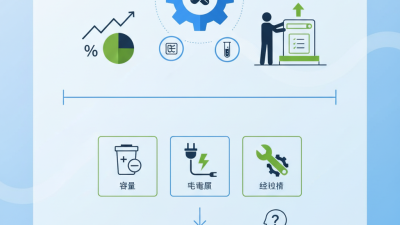
Syringe assembly machines automate component feeding, barrel and plunger assembly, stopper insertion, inspection, and output handling. The chart shows common nominal syringe capacities used across medical, laboratory, and industrial applications. These are capacity categories rather than market-share data; exact formats and graduation intervals vary by applicable standards and product design.

Quality control typically includes dimensional checks, component presence verification, stopper and plunger placement, visual inspection, and functional testing. Safety features may include guarded tooling, interlocked access doors, controlled motion, and validated handling of sterile components.