Blog
What Are the Best Powder Mixers from China?
Choosing the best Powder Mixers from China requires more than comparing prices or polished catalog photos. Performance depends on the material, batch size, moisture level, mixing time, and cleaning requirements. A ribbon mixer may suit dry powders, while a paddle, conical screw, or high-shear mixer may perform better with fragile or cohesive ingredients. The correct choice starts with the process.
Practical evaluation should include factory capability, welding quality, motor selection, sealing design, and test results using your actual powder. Watch the discharge. Does material leave the vessel evenly, or does residue remain near the corners? Ask for documented mixing uniformity, equipment drawings, surface-finish details, and maintenance guidance. Reliable manufacturers should explain their limits clearly, not only present attractive specifications.
Supplier verification also matters. Review production records, quality-control procedures, export experience, and relevant certifications for your target market. Food and pharmaceutical applications may require stricter hygienic design, traceability, and validation than general industrial use. Independent inspections and sample trials can reduce costly surprises. They cannot remove every risk.
No single mixer wins every test. A machine that handles flour smoothly may struggle with fine pigments or heat-sensitive powders. Some online comparisons oversimplify this point. That deserves caution. The strongest decision combines technical evidence, realistic operating conditions, after-sales support, and total ownership cost. With careful testing and honest communication, buyers can identify Chinese Powder Mixers that deliver dependable results rather than merely impressive specifications.
What Defines a High-Quality Powder Mixer from China?
What Are the Best Powder Mixers from China?
What Defines a High-Quality Powder Mixer from China?
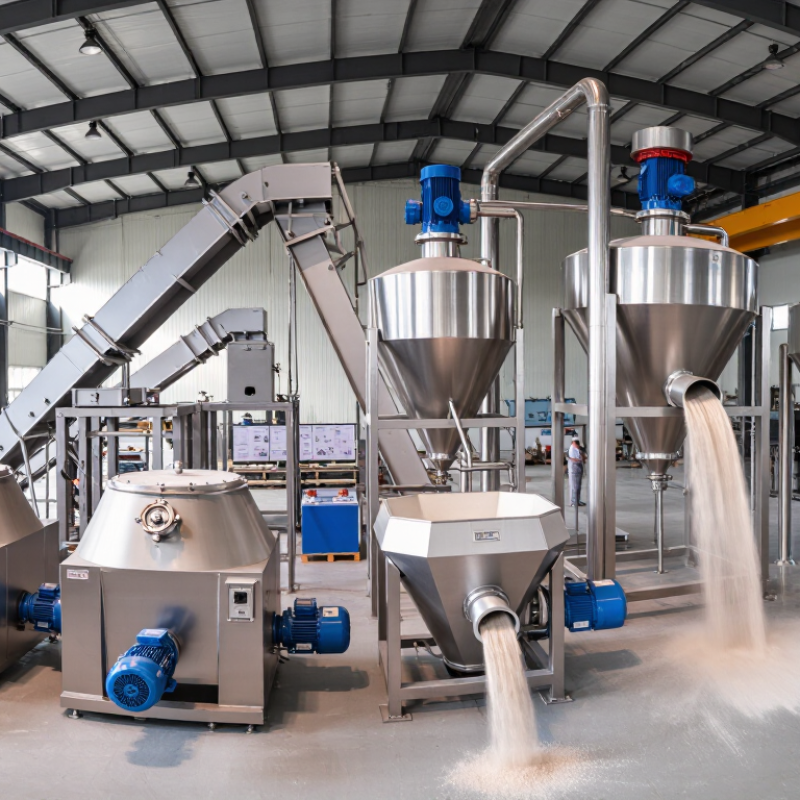
A high-quality powder mixer from China should prove its performance, not merely display a polished exterior. In practical evaluations, I examine the mixing chamber, shaft, blades, seals, and discharge valve. Stainless steel contact surfaces should be clean, corrosion-resistant, and suitable for the intended powder. Smooth welds matter. They reduce residue buildup and simplify cleaning between batches.
Mixing uniformity is the real test. A dependable supplier should provide trial data from different loads, such as 50%, 80%, and rated capacity. Test samples should be collected from several points, including the center and discharge area. The results should show consistent distribution, not just attractive laboratory photographs. A steady motor sound, controlled vibration, and stable temperature also indicate careful engineering. Small details reveal weaknesses.
Safety and maintenance deserve equal attention. Guards, emergency stops, grounding, and dust-control connections should be clearly documented. Replacement seals and bearings should be easy to identify. A responsible manufacturer can explain lead times, inspection procedures, cleaning requirements, and operator training. Factory audits can verify whether production matches the drawings. Still, visual inspection has limits. I have seen well-finished machines hide inconvenient access points and difficult discharge cleaning. That mistake is expensive. Ask for a live trial, maintenance records, material certificates, and references from comparable applications before making a decision.
Which Types of Chinese Powder Mixers Suit Different Materials?
Choosing a Chinese powder mixer should begin with the material, not the machine’s appearance. Ribbon mixers suit free-flowing powders such as flour, minerals, and detergent bases. Their horizontal trough creates steady movement at moderate speed. For cohesive powders, paddle or plowshare mixers usually provide stronger breakup. They also handle small liquid additions more effectively.
Sensitive materials need gentler treatment. Conical screw mixers create lifting and folding action with relatively low shear. They can suit heat-sensitive powders, pharmaceutical excipients, and fragile crystals. However, their discharge may be slower than a ribbon mixer. High-intensity mixers work better when powders need rapid agglomeration or controlled granulation. The wrong choice can increase dust, temperature, and segregation. It happens more often than suppliers admit.
Market data supports careful automation planning. Grand View Research valued the global industrial mixers market at about US$8.6 billion in 2023 and expects continued growth through 2030. Meanwhile, the International Federation of Robotics reported 541,302 industrial robots installed worldwide in 2023. These figures suggest rising demand for repeatable processing, but automation cannot correct poor material selection. Buyers should request test mixing with their actual powder, measuring blend uniformity, discharge time, temperature rise, and residue. A 5–10 kilogram sample can reveal problems that a polished factory demonstration hides. Material moisture, particle size, and bulk density must be recorded before comparing Chinese powder mixers.
| Powder Mixer Type | Operating Principle | Materials It Suits Best | Typical Applications | Key Advantages | Important Limitations | Recommended Selection |
|---|---|---|---|---|---|---|
| Ribbon Mixer | Inner and outer helical ribbons move powder in opposite axial directions, creating convective mixing. | Free-flowing powders, granules, dry premixes, flour, starch, salt, sugar, mineral powders and feed ingredients. | Food ingredients, animal feed, chemicals, fertilizers and general industrial dry blending. | Versatile, relatively simple to operate, suitable for large batches and capable of adding a limited amount of liquid. | Less suitable for very fragile particles or products that require extremely gentle handling. Cleaning can be slower when the product adheres to the trough. | Best general-purpose choice for routine dry powder and granule blending. |
| Paddle Mixer | Overlapping paddles lift, fold and disperse the material through the mixing chamber. | Free-flowing powders, granules, flakes, mildly cohesive materials and products with different particle sizes. | Food, feed, chemicals, minerals, biomass and premixes containing fragile or irregular particles. | Good mixing uniformity, comparatively gentle particle treatment and efficient handling of materials with varied bulk density. | Very cohesive powders may require a longer mixing time or an additional de-lumping device. | A strong option when particle protection and uniformity are both important. |
| Ploughshare Mixer | Plough-shaped tools create three-dimensional circulation; high-speed choppers can break agglomerates. | Cohesive powders, powders with lumps, powders requiring rapid dispersion and mixtures containing a moderate liquid addition. | Construction chemicals, detergents, pigments, pharmaceuticals, specialty chemicals and dry mortar. | Fast mixing, strong de-agglomeration and effective dispersion of difficult powders. | Higher mechanical energy may damage fragile particles. Choppers and seals can increase maintenance requirements. | Best for cohesive, lumpy or difficult-to-disperse powders that need intensive treatment. |
| High-Shear Mixer | Fast rotating blades or cutters generate intense shear, dispersion and de-lumping action. | Cohesive powders, agglomerated powders, powders requiring binder distribution and products needing rapid wetting or granulation. | Pharmaceutical processing, chemical formulations, detergents and specialty powder production. | Excellent de-agglomeration, rapid dispersion and strong control over powder structure during intensive processing. | Can generate heat, dust and particle breakage. It is generally less suitable for delicate, friable or highly abrasive products without process control. | Choose when dispersion and lump reduction are more important than gentle handling. |
| V-Blender | Two connected vessels repeatedly divide and recombine the powder as the V-shaped shell rotates. | Dry, free-flowing powders and granules with similar flow characteristics and low cohesion. | Pharmaceutical powders, food ingredients, nutraceuticals and laboratory-scale dry blending. | Gentle mixing, low particle damage and relatively simple internal geometry. | Not ideal for sticky, cohesive or heavily segregating materials. Liquid addition and de-lumping performance are limited. | Best for gentle blending of clean, dry and free-flowing powders. |
| Double-Cone Blender | A rotating double-cone vessel repeatedly tumbles and divides the powder bed. | Free-flowing powders and granules that are sensitive to attrition or heat. | Pharmaceuticals, food powders, cosmetics and fine chemical products. | Gentle operation, low heat generation and easy discharge when fitted with a suitable outlet. | Mixing can be slow for cohesive materials. It has limited capability for breaking lumps or distributing significant liquid quantities. | Suitable for fragile, dry products where low shear and low heat are priorities. |
| Conical Screw Mixer | A rotating screw lifts material upward along the vessel wall while gravity returns it downward, producing axial circulation. | Fine powders, cohesive powders, powders with a wide range of bulk densities and heat-sensitive products. | Pharmaceuticals, specialty chemicals, pigments, food powders and high-value ingredients. | Good vertical circulation, relatively gentle mixing and effective blending of powders with different densities. | Usually has a higher purchase cost and more complex mechanical design than a basic ribbon mixer. Extremely sticky materials may still require special tools. | A good choice for fine or cohesive powders and products prone to segregation. |
| Planetary Mixer | One or more mixing tools rotate around the vessel while also rotating about their own axes. | Very cohesive powders, pastes, high-viscosity mixtures and powder-liquid systems. | Adhesives, sealants, ceramics, battery materials, pharmaceutical formulations and specialty compounds. | High torque, strong wall scraping and effective processing of dense or highly viscous formulations. | Usually slower and more energy-intensive for ordinary free-flowing powders. It may require careful cleaning and temperature control. | Use for high-viscosity or highly cohesive products rather than simple dry blending. |
| Continuous Plough or Paddle Mixer | Material is continuously conveyed and mixed through a chamber while feed rates control residence time. | Consistent free-flowing powders, granules and formulations requiring continuous production. | Food, feed, chemicals, minerals and automated production lines. | Supports continuous processing, reduced batch-to-batch interruption and integration with automated feeding systems. | Requires stable feeding and careful residence-time control. It is less flexible than a batch mixer for frequent product changes. | Best for high-throughput production with stable recipes and controlled material flow. |
| Selection note: For most free-flowing dry powders, start with a ribbon, paddle, V or double-cone mixer. For cohesive or lumpy powders, consider a ploughshare, high-shear or conical screw mixer. For very viscous powder-liquid systems, a planetary mixer is generally more suitable. Final selection should be verified through tests using the actual powder, because moisture, particle size, bulk density, abrasiveness, required batch size and cleaning requirements strongly affect performance. | ||||||
How to Compare Powder Mixer Performance, Capacity, and Cost
What Are the Best Powder Mixers from China?
How to Compare Powder Mixer Performance, Capacity, and Cost
When comparing Chinese powder mixers, focus on measurable output rather than catalog claims. Test blend uniformity with representative samples and a validated laboratory method. Record mixing time, fill level, discharge residue, and power consumption. The U.S. Department of Energy reports that motor-driven systems use about 70% of industrial electricity. A low purchase price may hide higher motor and gearbox costs.
Capacity also needs careful examination. A mixer rated at 1,000 liters may perform poorly at 100 liters. Compare minimum and maximum fill volumes, bulk density, and usable volume. Measure throughput in tonnes per hour, not only batch size. For fragile powders, inspect particle damage after discharge. Dust-control records should reflect NFPA 652 principles where applicable. Safety is not an accessory.
Total cost includes installation, cleaning, spare parts, validation, and downtime. Request results from an actual test batch, with moisture and particle size clearly stated. ISO 9001 supports process control, but it does not prove mixing quality. That distinction matters. The DOE life-cycle cost method is useful, yet it may overlook local maintenance skills. A small factory might prefer simple repairs over advanced automation. Compare three quotations using identical specifications, then inspect welds, seals, controls, and service response. A spreadsheet can still mislead.
Which Chinese Powder Mixer Features Improve Efficiency and Reliability?
Chinese powder mixers can improve production when their design matches the material, batch size, and cleaning routine. In factory evaluations, ribbon and paddle mixers often deliver even blending through carefully shaped blades. Variable-frequency drives help operators adjust speed without changing motors. This matters for powders that shear, heat, or separate easily. Short mixing cycles save energy, but only when the chamber avoids dead zones. That detail is easy to miss.
Reliable machines use stainless-steel contact surfaces, sealed bearings, and reinforced discharge valves. Smooth internal welds reduce powder buildup and simplify inspection. Quick-opening covers give technicians safer access for cleaning and maintenance. Some models include load cells, temperature sensors, and programmable controls. These features support repeatable batches and provide useful production records. Calibration still matters. Sensors can drift.
A practical supplier should provide material certificates, weld inspection records, surface-finish information, and factory acceptance testing. I would also request a trial using the actual powder, not a convenient substitute. Moisture, particle size, and density can change the result significantly. One overlooked feature is the gasket design. A durable gasket may reduce leakage, but an awkward shape can slow cleaning. Chinese powder mixer manufacturers offer many configurations, yet the most efficient choice is not always the fastest machine. It is the one that remains consistent after repeated batches, cleaning cycles, and ordinary operator mistakes.
What Are the Best Powder Mixers from China?
Which Chinese powder mixer features improve efficiency and reliability?
This indicative, brand-neutral engineering benchmark compares common powder mixer configurations on a 0–100 scale. Variable-speed drives, optimized blade geometry, enclosed dust control, sanitary access, robust shaft sealing, and automated monitoring can improve throughput consistency, product protection, maintenance access, and operating reliability. Actual performance depends on powder properties, batch size, formulation, and process conditions.
How to Select a Reliable Chinese Powder Mixer Supplier
Selecting a reliable Chinese powder mixer supplier requires more than comparing prices. Grand View Research estimates the global industrial mixer market will expand at roughly 6% annually through 2030. That growth attracts capable manufacturers and inexperienced traders. Ask for factory ownership, production records, export references, and quality certificates. Verify each document independently. A certificate alone proves little.
Request a material test using your actual powder, moisture level, and batch size. Review mixing uniformity, sampling methods, discharge residue, and cleaning time. For sensitive powders, inspect seals, weld quality, dust control, and contact materials. Require a written acceptance standard, such as mixing coefficient of variation. A good supplier should provide drawings, motor data, spare-parts lists, and maintenance instructions before payment. This is where many buyers become too optimistic.
The 2023 UNCTAD Review of Maritime Transport states that ships carry over 80% of global merchandise trade. Therefore, packaging and shipping controls deserve the same attention as machine design. Check export packing, insurance, installation support, and response times across time zones. Ask for factory acceptance testing through recorded videos or an independent inspection. I would not select the cheapest quotation without comparing warranty exclusions and lead-time penalties. One overlooked detail can be the discharge valve. It may retain powder and distort the next batch. Supplier evaluation is never perfectly objective; even experienced buyers can overvalue polished presentations. Real evidence matters more.
Related Posts
-
How to Choose the Best Powder Mixers for Your Business
-
What Is Mixer Powder and How Is It Used?
-
10 Best Powder Mixture Machine Suppliers Worldwide?
-
Top 10 Mixing Powder Machines for Global Buyers in 2026?
-
Top Mesin Mixer Powder for Efficient Mixing Solutions?
-
Why Choose the Right Mixing Powder Machine for Your Business?